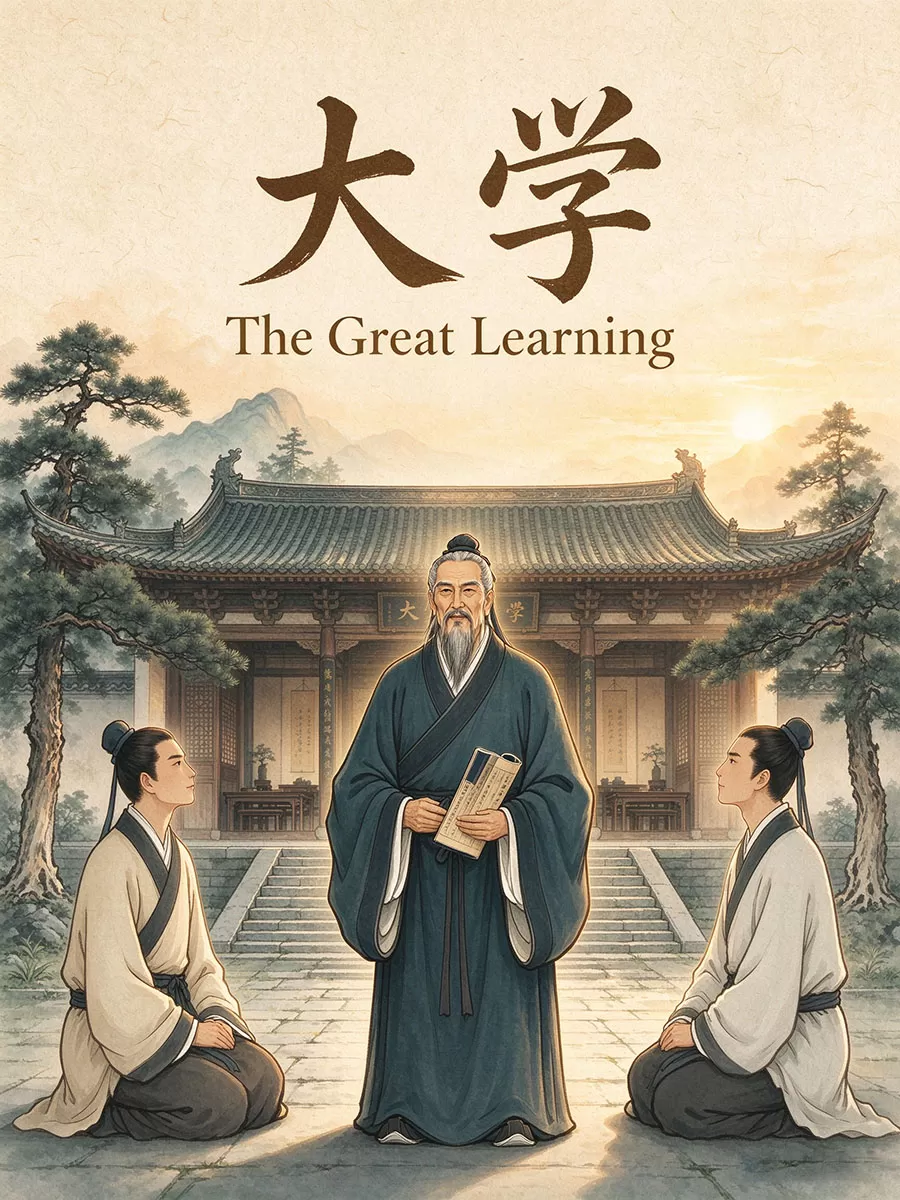
The Great Learning
Summary
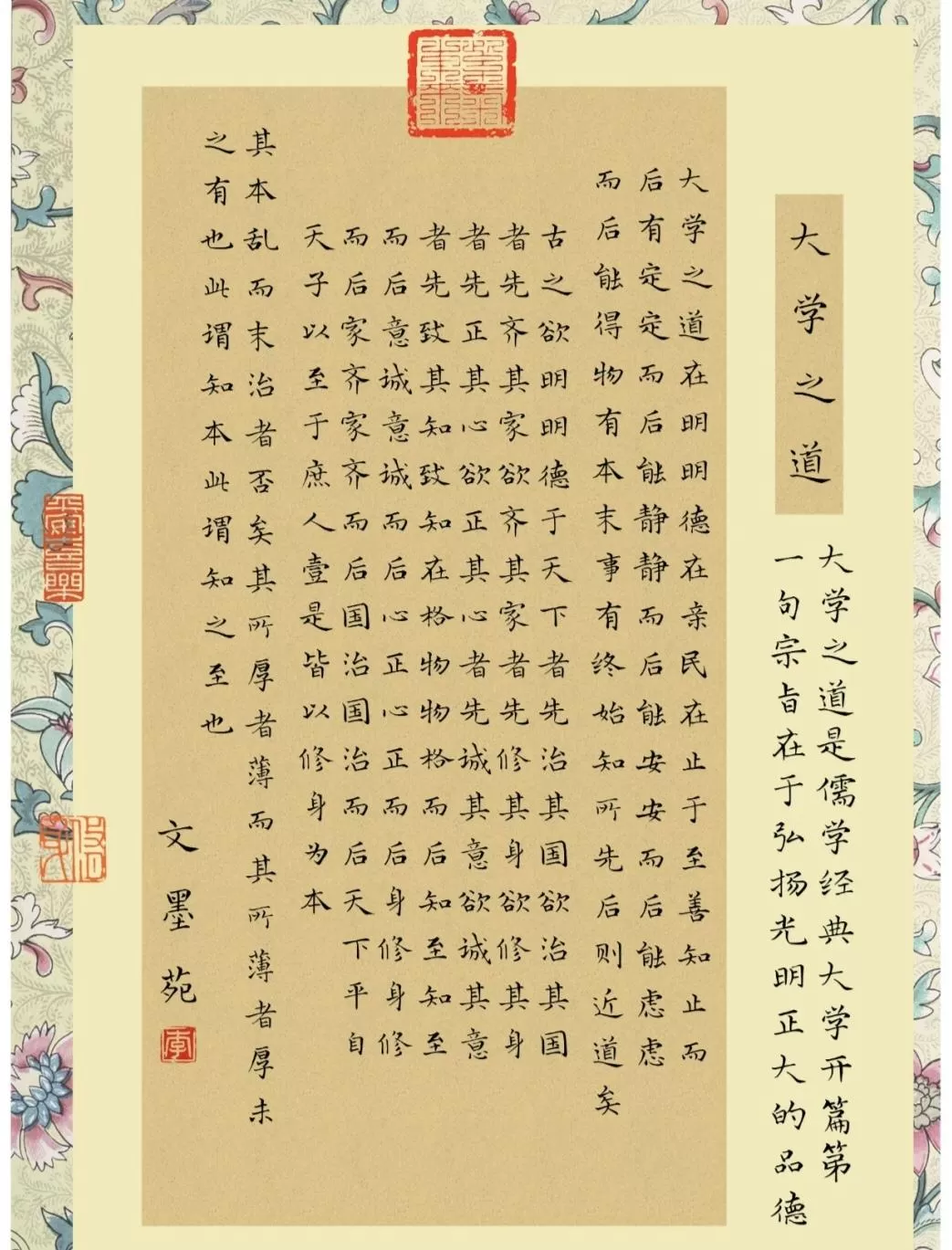
The Great Learning is a prose essay expounding on the Confucian ideas of self-cultivation, family regulation, governing the state, and bringing peace to the world. Originally the 42nd chapter of The Book of Rites compiled by Dai De, it is...
Table of Contents
Introduction to The Great Learning
Introduction to The Great Learning
The Great Learning is a prose work discussing the Confucian philosophy of self-cultivation, family regulation, state governance, and universal peace. Originally the 42nd chapter of the Book of Rites (Liji), it is traditionally attributed to Zengzi of the Spring and Autumn and Warring States periods, though it is now recognized as a Confucian text from the Qin and Han dynasties. It stands as a vital ancient Chinese treatise on educational theory.
Elevated by the Northern Song philosophers Cheng Hao and Cheng Yi, and further annotated by Zhu Xi of the Southern Song in his Commentary on the Great Learning, it eventually joined The Doctrine of the Mean, The Analects, and Mencius to form the Four Books. From the Song and Yuan dynasties onward, The Great Learning became a state-sanctioned textbook and a mandatory text for imperial examinations, profoundly influencing Chinese education.
The text outlines the "Three Guiding Principles" (illustrating illustrious virtue, renovating the people, and abiding in the highest good) and the "Eight Steps" (investigating things, extending knowledge, sincerity of will, rectifying the mind, cultivating the self, regulating the family, governing the state, and pacifying the world). It emphasizes that self-cultivation is the foundation for governing others, with the ultimate aim of achieving universal peace, underscoring the unity of moral integrity and political governance.
Written in concise yet profound language, The Great Learning summarizes pre-Qin Confucian theories on moral cultivation, principles, and methods, while systematically elaborating on Confucian political philosophy. It offers deep insights into ethics, governance, and societal harmony.
Dating of The Great Learning
The Great Learning originates from the Book of Rites, compiled during the Han dynasty by Dai Sheng. The dynastic historian Ban Gu noted that the Book of Rites comprised works by later disciples of Confucius, likely composed between the early Warring States period and the early Western Han.
The Qing scholar Cui Shu argued that the text’s elaborate and parallel prose style suggests a Warring States origin (5th century BCE). Modern scholarship generally attributes it to Zengzi’s school, placing its composition in the early Warring States period.
Core Philosophy of The Great Learning
The text focuses on the relationship between personal moral cultivation and governance, encapsulated in the ideal of "self-cultivation to bring peace to the people." Its themes revolve around the Three Guiding Principles and Eight Steps, expanding Confucian ideals of self-improvement and active societal engagement.
While advocating for benevolence and people-centered governance, the text reflects feudal class distinctions. Concepts like "illustrious virtue" and "highest good" served as ethical standards for rulers, while the Eight Steps merged personal cultivation with political ideology. Though rulers are portrayed as "parents of the people," their advocacy for "loving the people" ultimately aimed to preserve their own privileged status.
Commentaries on The Great Learning
-
Cheng Yi: "The Great Learning is a surviving work of Confucius, the gateway to virtue for beginners. It alone preserves the ancients’ order of learning, surpassing even The Analects and Mencius. Scholars must follow it to avoid error."
-
Zheng Xuan: "It is titled The Great Learning because it teaches that broad learning prepares one for governance."
-
Kong Yingda: "This chapter discusses how mastering learning enables one to govern a state and illuminate virtue across the world."
-
Sun Yat-sen: "China’s political philosophy, as seen here, is uniquely systematic. No foreign political philosopher has articulated such ideas—it is a treasure exclusive to China."
Legacy of The Great Learning
As part of the Book of Rites, The Great Learning profoundly influenced Han Confucianism. With the rise of Neo-Confucianism and the imperial examination system, it became indispensable to literati, shaping their ideals of "cultivation, regulation, governance, and peace." The text promoted self-improvement, social responsibility, and stability, fostering values of compassion, public welfare, and national unity. Its vision of moral and political harmony left an enduring mark on Chinese intellectual and cultural history.