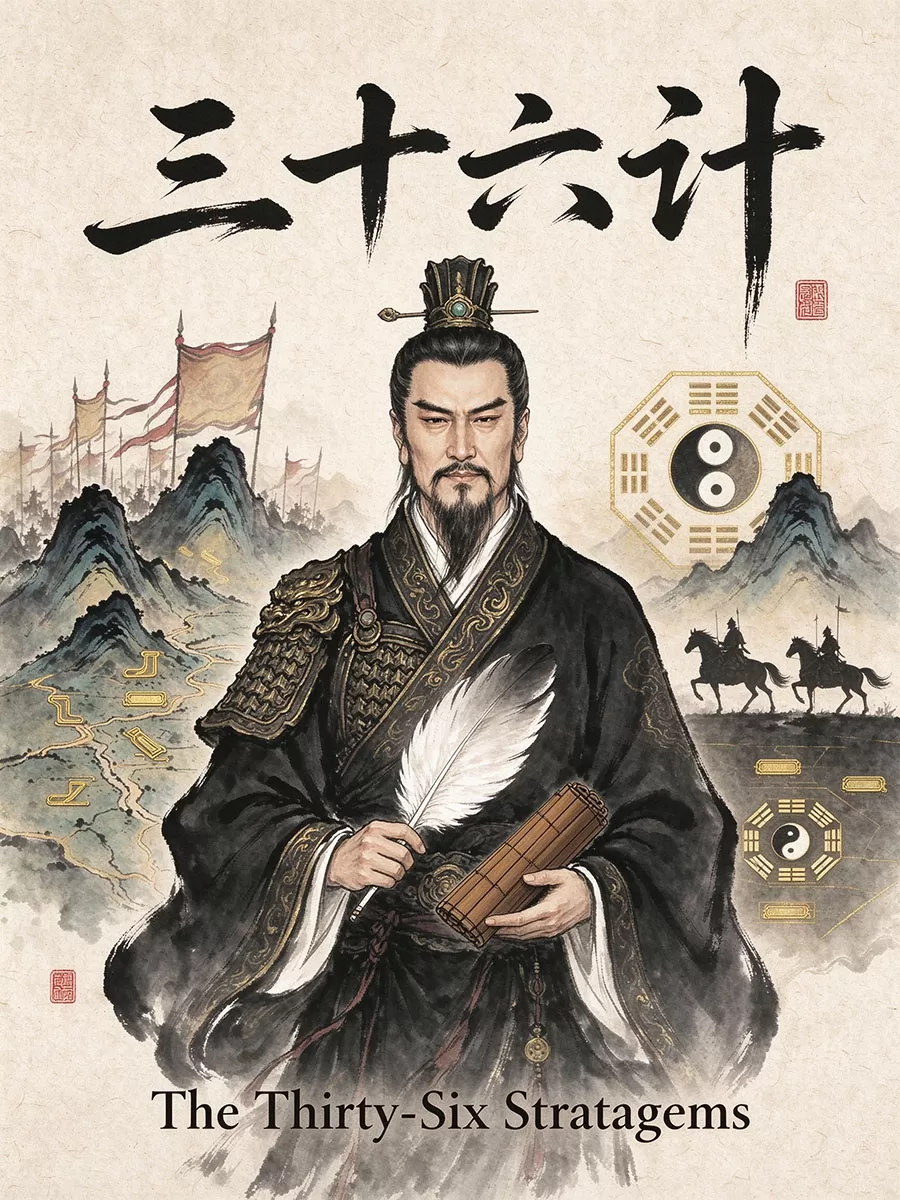
The Thirty-Six Stratagems
Summary
The Thirty-Six Stratagems, also known as the Thirty-Six Schemes, is a collected military work of thirty-six ancient Chinese military strategies. It is also a military studies work based on ancient military thought and the summarized experience of...
Table of Contents
- Chapter 1 · Deceive the Heavens and Cross the Sea
- Chapter 2 · Besiege Wei to Rescue Zhao
- Chapter 3 · Kill with a Borrowed Sword
- Chapter 4 · Wait at Leisure while the Enemy Labors
- Chapter 5 · Loot a Burning House
- Chapter 6 · Make a Sound in the East, then Strike in the West
- Chapter 7 · Create Something Out of Nothing
- Chapter 8 · Openly Repair the Gallery Roads, but Sneak through the Passage of Chencang
- Chapter 9 · Observe the Fire on the Opposite Bank
- Chapter 10 · Hide a Dagger Behind a Smile
- Chapter 11 · Sacrifice the Plum Tree to Preserve the Peach Tree
- Chapter 12 · Take the Opportunity to Pilfer a Goat
- Chapter 13 · Beat the Grass to Startle the Snake
- Chapter 14 · Borrow a Corpse to Resurrect the Soul
- Chapter 15 · Lure the Tiger out of the Mountain
- Chapter 16 · Let Go to Catch
- Chapter 17 · Tossing out a Brick to Get a Jade
- Chapter 18 · Capture the King to Capture the Thieves
- Chapter 19 · Remove the Firewood from under the Pot
- Chapter 20 · Catch Fish in Troubled Water
- Chapter 21 · The Cicada Sheds Its Shell
- Chapter 22 · Trap the Thief Behind Closed Doors
- Chapter 23 · Ally with Distant States to Attack Nearby Ones
- Chapter 24 · Borrow the Road to Attack Guo
- Chapter 25 · Steal the Beams and Replace the Pillars
- Chapter 26 · Scold the Locust Tree While Pointing at the Mulberry Tree
- Chapter 27 · lay Dumb, But Not Crazy
- Chapter 28 · Pulling the Ladder After Climbing Up
- Chapter 29 · Flowers Blooming on a Tree
- Chapter 30 · The Guest Becomes the Host
- Chapter 31 · The Beauty Trap
- Chapter 32 · The Empty City Stratagem
- Chapter 33 · The Counter-Spy Stratagem
- Chapter 34 · The Self-Injury Stratagem
- Chapter 35 · The Linked Stratagem
- Chapter 36 · The Best Stratagem Is to Run Away
Introduction to The Thirty-Six Stratagems
The Thirty-Six Stratagems
The Thirty-Six Stratagems, also known as the Thirty-Six Schemes, is a collected military work of thirty-six ancient Chinese military strategies. It is also a military studies work based on ancient military thought and the summarized experience of struggles across successive dynasties.
Content Introduction: The Thirty-Six Stratagems is divided by scenario of use into six sets: Victory Stratagems, Enemy-Engagement Stratagems, Offensive Stratagems, Chaos Stratagems, Combined-Operation Stratagems, and Defeat Stratagems, with six stratagems in each set, totaling thirty-six. The first three sets are strategies used when one’s own side holds the advantage; the last three sets are response strategies for when one is at a disadvantage.
Background of Creation: The phrase “Thirty-Six Stratagems” originates from the military practice of Tan Daozhi of the Liu Song dynasty of the Southern Dynasties. During the Tang and Song dynasties it was continuously used by literati and military specialists, and records of it are scattered through various historical sources. In the late Ming and early Qing dynasties, some scholars collected military strategies and battle cases from successive dynasties and compiled them into a systematic transmitted edition of the Thirty-Six Stratagems.
Artistic Characteristics: The structure of the Thirty-Six Stratagems is arranged in numerical order. In “within number there is art, within art there is number,” it displays the variability and bizarre diversity of war strategy. The explanations of each stratagem rely on the principle of yin-yang change in the I Ching and integrate the ancient military ideas of the opposition and transformation of hardness and softness, the orthodox and the unorthodox, offense and defense, and so on, possessing a character of naive dialectics. As a representative symbol of traditional Chinese strategic culture, expressions related to the Thirty-Six Stratagems have entered the daily context of the Chinese language and remain an important popular vehicle through which the general public understands ancient military wisdom.
Historical Sources
Some names of the “stratagems” come from historical allusions, such as “Besiege Wei to Rescue Zhao” and “Borrow a Road to Attack Guo”; some come from ancient military terminology, such as “Wait at Ease for the Exhausted Enemy” and “Make a Noise in the East and Attack in the West”; some come from lines by ancient poets, such as “The Plum Tree Withers in Place of the Peach Tree” and “Catch the Bandit by First Catching the King”; some borrow well-known idioms as titles, such as “Slough Off the Cicada’s Golden Shell” and “Point at the Mulberry and Abuse the Locust”; and still others come from other sources. These stratagem names are easy to understand and remember, and convenient for circulation among the people. The content of each “stratagem” mostly belongs to the strategies of ancient military theorists. Although the text under each “stratagem” is not long, it is very concise. The concluding remarks of each “stratagem” are all deduced according to the principle of yin-yang change in the I Ching and the ancient military thought of the mutual transformation of such opposites as hardness and softness, the orthodox and the unorthodox, offense and defense, the enemy and oneself, the substantial and the insubstantial, host and guest, labor and ease, favorable and unfavorable, high and low, death and life, giving each “stratagem” a color of naive military dialectics.
Date of Compilation
The phrase “Thirty-Six Stratagems” predates the year in which the book was compiled. Its linguistic origin can be traced to Tan Daozhi (d. 436), a general of the Liu Song dynasty. According to the “Biography of Wang Jingze” in the Book of Southern Qi: “Lord Tan had thirty-six schemes; flight is the best. You father and son should only flee.” This means that when defeat is certain and irreversible, the only best policy is retreat. Later generations continued to use this phrase. In the Song dynasty, Huihong’s Lengzhai Yeyu says: “Of the thirty-six stratagems, flight is the best.” By the late Ming and early Qing, even more people quoted this phrase. Thereupon someone with an interest collected books from various sources and compiled the Thirty-Six Stratagems. However, it is now difficult to ascertain exactly when and by whom this book was written.
Thought of the Work
Most of the stories in the Thirty-Six Stratagems are known to every household and need little explanation, such as “Slough Off the Cicada’s Golden Shell,” “Catch the Bandit by First Catching the King,” “Use Double Agents,” “Lure the Tiger Down from the Mountain,” “Secretly Cross at Chencang,” “Flight Is the Best,” “Catch Him by Letting Him Go,” “Empty Fort Strategy,” “Inflict Injury on Oneself to Win Trust,” “Use Beautiful Women,” “Make a Noise in the East and Attack in the West,” and “Besiege Wei to Rescue Zhao.” All are very familiar to people.
Take “Besiege Wei to Rescue Zhao” as an example. During the Warring States period, Wei besieged the Zhao capital of Handan. Zhao asked Qi for help, and the King of Qi sent Tian Ji and Sun Bin to lead troops to rescue Zhao. At the time, Tian Ji prepared to go directly to Handan. Sun Bin said, however, that Wei’s elite troops were all concentrated at Handan and its domestic forces were empty. If Qi attacked Wei’s capital Daliang at this moment, the Wei army would certainly turn back to save itself. Tian Ji accepted this proposal and advanced toward Daliang. The Wei army indeed took the bait and hurriedly returned home. Taking advantage of the enemy’s exhaustion after a long march, the Qi army defeated it in one blow and lifted the siege of Handan. Thereafter, this “besiege Wei to rescue Zhao” strategy was often used by military specialists. The Thirty-Six Stratagems includes it in the first set, Victory Stratagems, and points out: “To attack a concentrated enemy is not as good as to divide him; to attack his yang is not as good as to attack his yin.” This means that to attack a concentrated enemy, it is better first to find a way to disperse him and then attack him separately; first strike the enemy whose momentum is weak, and afterward strike the enemy whose momentum is strong. In actual combat this means that when the enemy is too strong, one should avoid a direct confrontation, adopt circuitous tactics, disperse the enemy’s forces, and then concentrate an attack on the enemy’s weak links.
Another example is “Catch Him by Letting Him Go,” that is, in order to gain a deeper control over the enemy, one may first deliberately let him go, causing him to relax his guard and expose his defects, and finally take the opportunity to subdue him. For example, in the late Western Jin dynasty, the great general Shi Le used the stratagem of “catching him by letting him go” in order to eliminate Wang Jun, the military governor of Youzhou, who intended to rebel. At that time Wang Jun was powerful, and Shi Le feared it would be difficult to defeat him. He therefore first used a scheme to deceive him, bribed him with large quantities of treasures, and even wrote him a letter expressing willingness to support him as ruler. Soon afterward, one of Wang Jun’s subordinates, You Tong, betrayed Wang Jun and went to join Shi Le. Shi Le executed him and presented his head to Wang Jun, and Wang Jun finally completely relaxed his guard against Shi Le. Later, Youzhou suffered a flood, and the people had insufficient food, yet Wang Jun ignored the people’s suffering and increased harsh taxes and levies, causing popular resentment to boil and military morale to waver. Shi Le judged that the time had come and personally led troops to attack Youzhou. Wang Jun still thought he was coming to support his accession as emperor and made no preparations for battle at all, so he was quickly defeated and captured. Thus Shi Le’s stratagem of “catching him by letting him go” finally achieved its effect.
In addition, some stratagems in the Thirty-Six Stratagems are relatively difficult to understand from the literal meaning alone, such as “Deck the Tree with Flowers.” The Thirty-Six Stratagems says: “This tree originally has no flowers, yet flowers can be made to appear on it. Cut colored paper and paste it on; those who do not look closely will not easily detect it. Let flowers and tree reflect each other and form an exquisite whole. This means deploying elite troops in a friendly army’s formation to complete its momentum and overawe the enemy.” The meaning is that the tree originally has no “flowers,” yet “flowers” are needed; one can cut out colored flowers and paste them on the tree, and unless one observes carefully it is hard to tell true from false. “Flowers” and “tree” reflect each other, making the whole exquisite and radiant. That is, one deploys one’s own elite troops within a friendly army’s position to create a powerful momentum and overawe the enemy. In concrete application, one is originally weak in strength but must borrow various factors to create the false appearance that one is very strong. During the Warring States period, Tian Dan of Qi once used this stratagem to drive back the Yan army, whose strength far exceeded his own. At the time, Tian Dan ordered more than a thousand oxen to be gathered; sharp knives were tied to their horns, oil-soaked reeds were tied to their tails, and the oxen were draped in five-colored dragon-patterned cloth. At night, Tian Dan ordered the reeds on the oxen’s tails to be set on fire. The frightened oxen charged madly toward the Yan camp, followed by five thousand brave Qi warriors, while other soldiers and civilians beat drums and shouted to encourage them. The Yan army was so frightened by their momentum that it fell into disorder and was quickly defeated.
Compilation Features
The first feature of the book is that its structure is arranged in numerical order. As its preface says: “Six times six is thirty-six; in number there is art, in art there is number. Yin and yang are harmonized, and the mechanism lies within. The mechanism cannot be contrived; if contrived, it will not hit the mark.” The author believes that the laws of war can be sought; historical war experience can be used to learn from success and failure and thereby gain lessons. It is only that war strategy changes in many ways and is bizarre and hard to grasp. Therefore these thirty-six countermeasures are important strategies that commanders must study and must not be underestimated. Before applying a countermeasure, one must first examine the situation; if the situation is not clear, one must “when in doubt, seek the facts; observe before acting,” and must not let slip the opportunity that “even the slightest gap must be exploited.” Even more important is to value the strategy of “attacking the mind and robbing the enemy of morale” and thereby “dissolving his momentum.” In application, one must conform to “reason and human feelings.” “If something is done without precedent, the strange and unusual will immediately show, shocking people and confusing custom, and the plot will be exposed.” Therefore one must certainly guard against “risky stratagems.” When in the inferior condition that “the enemy’s power is at its height and we cannot fight,” one must resolutely adopt the stratagem “flight is the best,” in order to achieve the goal of “a turning point to victory.”
Another feature of the book is that the explanatory words for each stratagem are mostly composed of diction from the I Ching. Ancient Chinese military thinkers such as Sun Wu, Han Xin, and Li Jing all mastered the principles of the I Ching and applied them to military affairs. The Ming dynasty military theorist Zhao Benxue once systematically applied the I Ching to military affairs, wrote works, and taught students; see the “Biography of Yu Daxian” in the History of Ming. According to another record by the famous general Yu Dayou: “I read the Taobian Neiwai Pian transmitted by my former teacher for many years; grasping its main idea, I know that none of it is not rooted in the I Ching.” See Wubei Zhi, juan 64, Yu Dayou. The author of the Thirty-Six Stratagems also deduced the yin-yang harmonization of the I Ching into the military changes of hardness and softness, the orthodox and the unorthodox, advance and retreat, and offense and defense, and it is quite naive-dialectical.
Later Influence
The stratagems in the Thirty-Six Stratagems all have high practical value and have been extended and applied to many fields such as politics, diplomacy, and economics. Besides circulating widely in China, it has also spread to countries throughout the world and is highly regarded by many foreigners.
Mr. Wu Gu’s translated and annotated Thirty-Six Stratagems has sold more than 500,000 copies since its public publication in 1979. The New Compilation of the Thirty-Six Stratagems, adapted by General Li Bingyan, has printed 1.61 million copies and is very popular. The “Thirty-Six Stratagems” has not only been made into comic strips but also into a television series. In June 1992, “Talks on the Thirty-Six Stratagems Ancient and Modern,” launched by CCTV’s “Military World,” achieved extremely high ratings after broadcast. The Thirty-Six Stratagems is listed alongside Sun Tzu’s Art of War from more than two thousand years ago as a classic of military studies.
Since the 1970s, the Thirty-Six Stratagems has been translated into several languages and widely disseminated throughout the world. Among these, there are more than ten English translations. The Swiss sinologist Harro von Senger (H. V. Senger), after many years of studying the Thirty-Six Stratagems, wrote the German work Strategeme; after publication it produced a sensation in the West, and the then German Chancellor Kohl personally wrote to him in praise. The book was later translated into French, Italian, Dutch, Russian, Chinese, and many other languages and circulated widely throughout the world.
Author Controversy
According to the names of the “thirty-six moves” contained in the modern scholar Zhu Lin’s Hongmen Zhi, apart from slight differences in a few stratagem names, they are mostly identical with the current Thirty-Six Stratagems. Zhu Lin also says in an annotation: “The thirty-six moves are also called the thirty-six stratagems, that is, thirty-six kinds of schemes. In warfare and in dealing with the world, they are effective everywhere. What is called ‘divine calculation and wonderful planning’ is therefore called Hongmen philosophy.” On September 16, 1961, Shuhe wrote an article in the “Dongfeng” supplement of Guangming Daily introducing this discovery. This unique copy was later translated and annotated by Mr. Wu Gu (Yao Wei) and circulated relatively widely; many of the numerous publications of the Thirty-Six Stratagems popular on the market today all derive from it.
According to the “Biography of Wang Jingze” in the Book of Southern Qi: “Lord Tan had thirty-six schemes; flight is the best. You father and son should only flee.” This is the earliest statement of the “thirty-six stratagems” verified by experts in literary and historical studies. It specifically describes the allusion of Tan Daozhi, who in that year imitated Marquis Wu Zhuge Liang’s method for defeated troops and safely withdrew when food was exhausted and troops were spent. It has come down to the present as a common saying, meaning that when defeat is certain and irreversible, the only best policy is retreat.
There is another theory that the author of the Thirty-Six Stratagems was Sun Tzu. As a “Sage of War” of his generation, Sun Tzu wrote the specialized work on warfare Sunzi. Many ideas in the Thirty-Six Stratagems are exactly the same as those in Sun Tzu’s Art of War and come down in the same line. For example, the core of the strategy embodied in “Besiege Wei to Rescue Zhao” is “attack what the enemy must rescue.”
In 2003, Zhang Jingxuan, a researcher of military books in the ancient city of Xi’an, produced a 140,000-character manuscript of Secret Military Methods, compiled by his father Zhang Lianjia from the mid-1920s to the late 1960s. A more than 10,000-character “Six-Six Rows · Thirty-Six Stratagems” is an important part; its structure, classification, and content are richer and more complete than the current popular edition. The book is also called the Nine Rows Art of War, and the whole book is divided into nine rows (that is, nine volumes). Zhang Lianjia believed: “Human society has never left the struggle for life and the struggle of arms. The struggle for life is a matter of vitality; the struggle of arms is war.” “My secret edition follows the principles of the I Ching, takes half of the I Ching, omits the struggle for life, and takes only the struggle of arms; this is how the book was completed.”