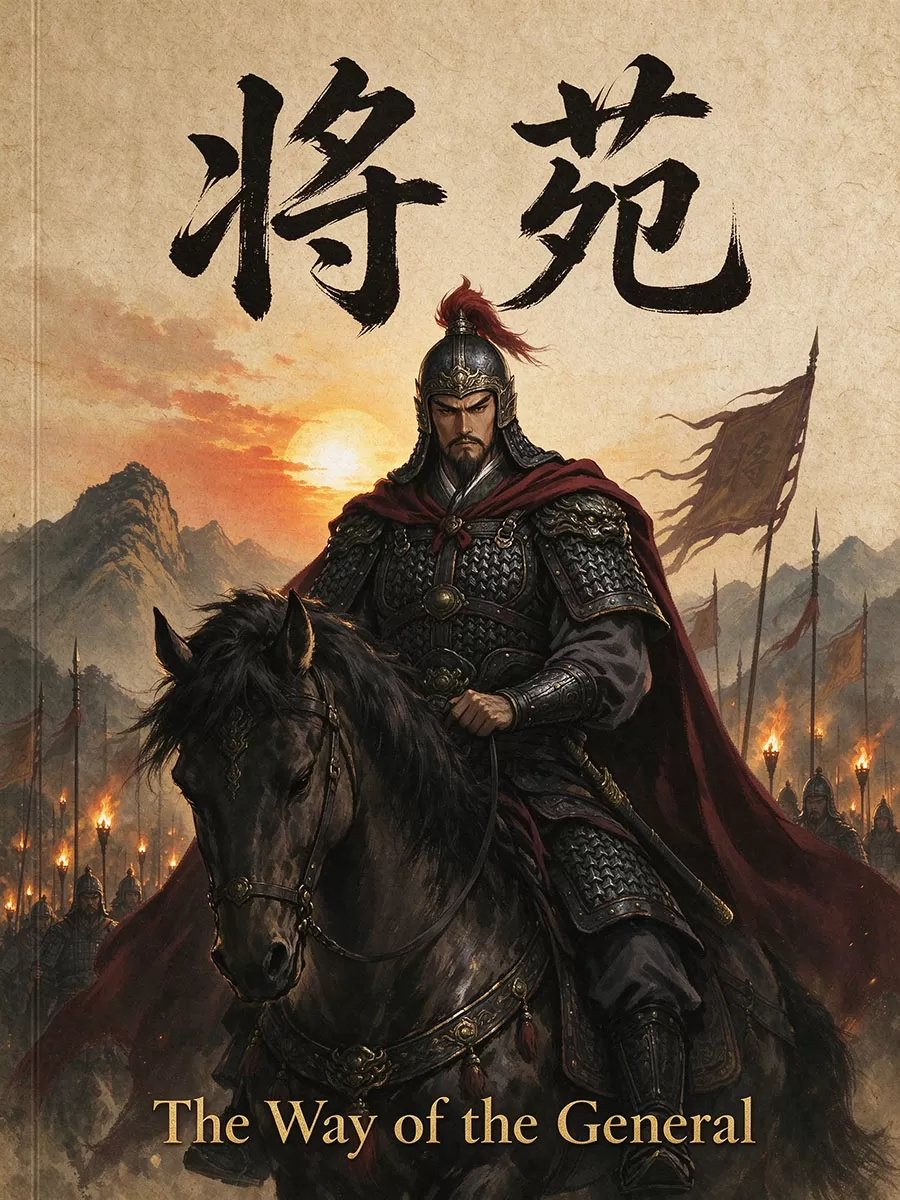
The Way of the General
Summary
Jiangyuan (The Garden of Generals) is an ancient Chinese military work devoted specifically to the way of being a general. It is also known as Zhuge Liang Jiangyuan, Wuhou Jiangyuan, Xinshu (Book of the Heart), Wuhou Xinshu, Xinshu (New Book), and...
Table of Contents
Introduction to The Way of the General
Jiangyuan (The Garden of Generals) is an ancient Chinese military work devoted specifically to the way of being a general. It is also known as Zhuge Liang Jiangyuan, Wuhou Jiangyuan, Xinshu (Book of the Heart), Wuhou Xinshu, Xinshu (New Book), and Wuhou Xinshu. In the Song dynasty it was called Jiangyuan; in the Ming dynasty it began to be called Xinshu (Book of the Heart), as in the Jingji Zhi; or Xinshu (New Book), as in Tao Zongyi’s Shuofu; and it was also sometimes called Jiangyuan, as in the Baichuan Shuzhi. Although the Han-Wei Congshu gives the title as Xinshu (Book of the Heart), the words Xinshu (New Book) appear in some chapter headings. In extant editions all these titles are found; examination of their contents shows some differences, but they are basically the same work under different names.
Jiangyuan is first recorded in You Mao’s Suichutang Bibliography of the Song dynasty under the title Zhuge Liang Jiangyuan, and it was also included in Ming-dynasty compilations of Zhuge Liang’s collected works. Yao Jiheng’s Gujin Weishu Kao (Examination of Pseudonymous Books Ancient and Modern) and Ji Yun’s Siku Quanshu Zongmu Tiyao (Annotated Catalog of the Complete Library of the Four Treasuries) in the Qing dynasty considered it a later pseudonymous work. Judging from the fact that much of its content is drawn from military and historical works and from the differing bibliographic records of the Sui and Tang, it does not appear to have been written by Zhuge Liang himself; nevertheless, many of its ideas are consistent with Zhuge Liang’s military thought.
Jiangyuan is a military work transmitted under the name of Zhuge Liang of the Three Kingdoms period. It was called Jiangyuan in the Song dynasty and first called Xinshu (Book of the Heart) in the Ming dynasty; it was also called Xinshu (New Book). It is first recorded in the Song-dynasty Suichutang Bibliography, but it does not appear in Chen Shou’s Sanguozhi (Records of the Three Kingdoms) or in the Sui and Tang dynastic bibliographies. Through the textual studies of Yao Jiheng’s Gujin Weishu Kao, the Siku Quanshu Zongmu Tiyao, and Gu Shi’s Chongkao Gujin Weishu Kao, it has mostly been judged to be a later work falsely attributed to Zhuge Liang. Extant version systems include the Han-Wei Congshu and the Tang-Song Congshu. A Tangut translation is preserved among the Khara-Khoto documents held in Britain and is the earliest extant translation into a minority script. The book is divided into two volumes and fifty chapters, each chapter being brief. It includes chapters such as “Military Authority,” “Terrain,” and “Expelling the Wicked.” It emphasizes that a general must hold command authority over the army (“the arbiter of the fate of the three armies”) and possess the Confucian qualities of benevolence, righteousness, propriety, wisdom, and trustworthiness.
The book discusses strategies for matching infantry, chariots and cavalry, and other arms to terrain, advocates the idea of elite troops with the saying “troops are not better for being numerous,” and promotes improving combat power through training. It also analyzes the military characteristics of the Northern Di and other neighboring peoples and strategies for defending the borders.
Zhuge Liang: A Brief Introduction
Zhuge Liang was the chancellor of Shu Han during the Three Kingdoms period and has been regarded by later generations as the embodiment of wisdom. In the history of Chinese military books there is a phenomenon whereby pseudonymous works were often attributed to ancient sages and worthies. Because Zhuge Liang was regarded by later generations as the embodiment of wisdom, the Siku Quanshu Zongmu Tiyao says, “Since the Song dynasty, military works have mostly been attributed to Liang.” Various bibliographies record more than twenty military books attributed to Zhuge Liang, and Jiangyuan is one of these pseudonymous works.