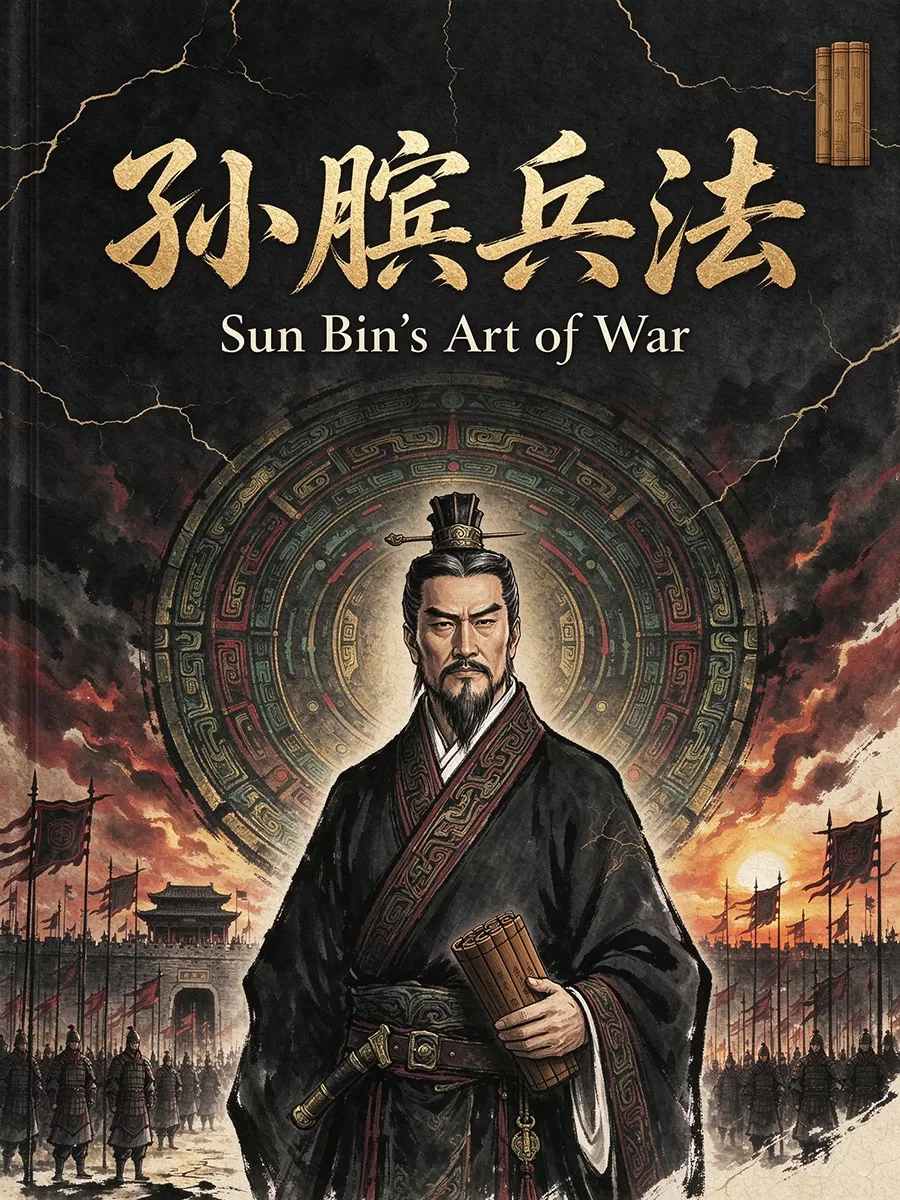
Sun Bin's Art of War
Summary
Sun Bin's Art of War is a military treatise written by Sun Bin, a military strategist of the State of Qi during the Warring States period, and his disciples. It was completed in the 4th century BCE and was originally recorded in the “Treatise on...
Table of Contents
Introduction to Sun Bin's Art of War
Sun Bin's Art of War is a military treatise written by Sun Bin, a military strategist of the State of Qi during the Warring States period, and his disciples. It was completed in the 4th century BCE and was originally recorded in the “Treatise on Literature” of the Book of Han, after which it was lost. In 1972, a bamboo-slip version was unearthed from the Han tomb at Yinqueshan, Linyi, Shandong. It contains upper and lower sections totaling 16 chapters and covers records of actual battles such as the Battle of Guiling and the Battle of Maling, confirming that it is an independent work from Sunzi's Art of War.
The core of the book is “valuing strategic posture.” It advocates “guiding circumstances according to the situation and turning them to advantage,” emphasizes the flexible use of terrain and strategic posture, and, based on practical combat experience, proposes that “enriching the state” is the foundation for a strong army. It stresses war preparation and conforming to the people's nature. Its contents include classic tactics such as besieging Wei to rescue Zhao and reducing cooking stoves to lure the enemy. It systematically discusses the classification of formations, troop deployment, and the qualities of generals. It inherits Sun Wu's idea of “utilizing strategic posture” and develops a dynamic, dialectical system of military theory. Through dialogue form, the book expounds the concept of “cautious war” and the operational elements of “favorable timing, geographical advantage, and harmony among the people,” reflecting the practical deepening of military thought during the Warring States period.
Content Synopsis
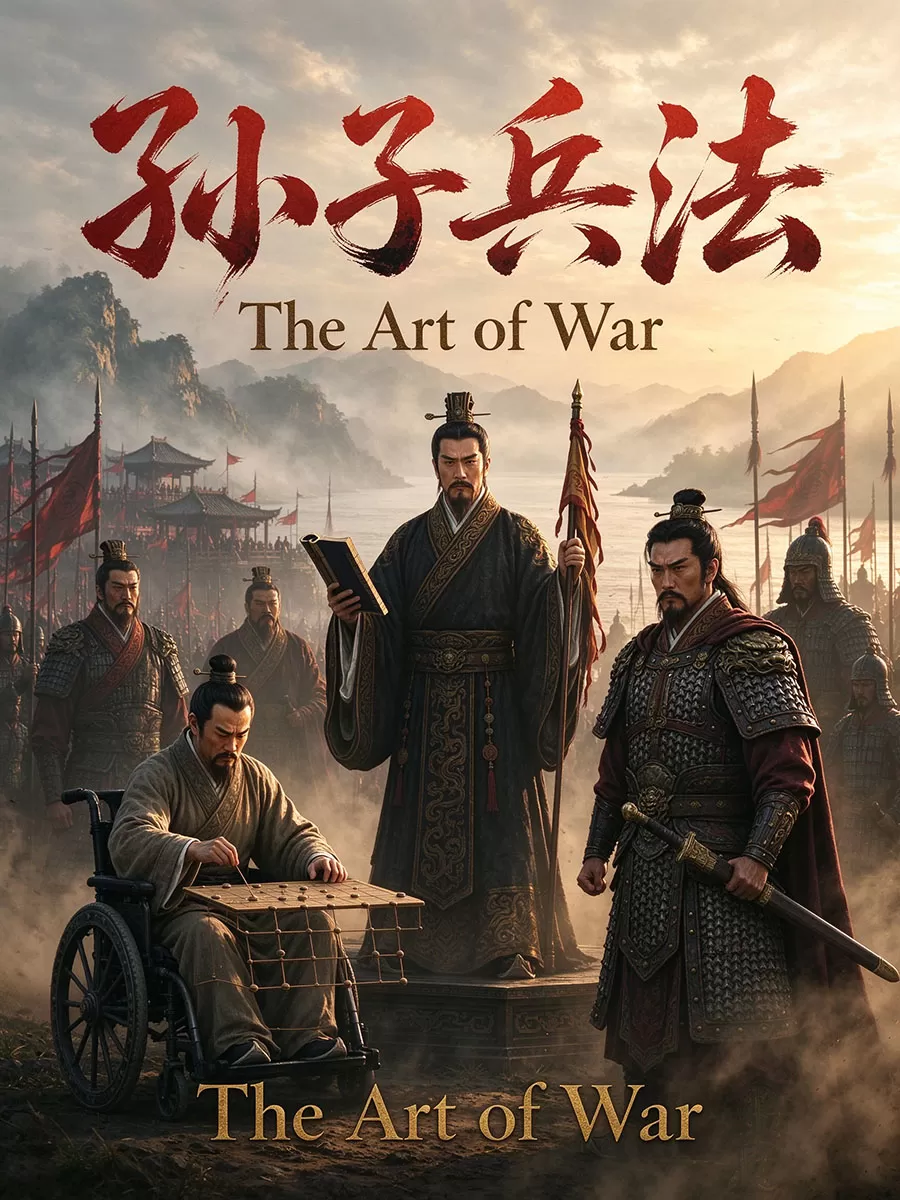
Pang Juan served King Hui of Wei and became a general. He secretly sent for Sun Bin to come to Wei, but upon seeing Sun Bin, he was jealous that Sun Bin's ability surpassed his own. Later he framed Sun Bin and had him subjected to the punishment of bin, the cruel corporal punishment of removing the kneecaps; hence later people called him Sun Bin.
With the help of friends, Sun Bin eventually escaped from Wei and went to Qi. He was highly valued by King Wei of Qi and became military adviser to the Qi general Tian Ji. He devised ingenious plans that decisively defeated the Wei army and shot Pang Juan to death. Later, Tian Ji was pushed out by Zou Ji and went into exile in Chu. Sun Bin probably followed him, which is why Wang Fu of the Han said, “Sun Bin cultivated his ability in Chu.” Among Warring States military specialists, Sun Bin was known for “valuing strategic posture,” that is, stressing flexible adaptation. He and Wu Qi were both famous military strategists of the time.
The earliest clear record that Sun Bin had a military treatise is in the Records of the Grand Historian. The “Treatise on Literature” of the Book of Han lists it alongside Wu Sunzi's Art of War, recording Qi Sunzi in 89 chapters and four scrolls of diagrams. According to textual research, Sun Bin's Art of War was probably lost before the Tang dynasty. This is because Emperor Wu of Wei's annotated Sunzi mentions, “Sun Bin said: In war, one fears that troops are not placed in a death-ground”; Zhao Rui of the Tang also mentioned in volume 9 of the Changduan Jing, “Sun Bin said: In war, one fears that the situation cannot be rescued”; and Du You's Tongdian, volume 149, contains a passage: “Sun Bin said: The use of cavalry has ten advantages.” But after the Bibliography of the Book of Sui, it is no longer recorded.
In February 1972, a bamboo-slip copy of Sun Bin's Art of War was unearthed from Han Tomb No. 1 at Yinqueshan, Linyi, Shandong, bringing this long-lost ancient book back to light. After careful collation, the bamboo-slip version of Sun Bin's Art of War was divided into upper and lower sections. The upper section contains fifteen chapters that can be determined to belong to Qi Sunzi, including “Capturing Pang Juan,” “Meeting King Wei,” “King Wei's Questions,” and “Chen Ji Asks about Fortifications.” The lower section consists of writings on military affairs that cannot yet be definitively attributed to Qi Sunzi. The number of chapters in the bamboo-slip version is far fewer than that recorded in the “Treatise on Literature,” and it is not a complete edition.
Background of Composition
The Battle of Guiling
In 354 BCE, Wei, with Pang Juan as general, sent troops to attack Zhao and besieged Handan. The following year, Handan, after a long siege, was in grave danger, while the Wei army had suffered heavy losses because it could not take the city for a long time. In response to Zhao's request, Qi appointed Tian Ji as general and Sun Bin as military adviser, and sent troops to strike Wei and rescue Zhao. Sun Bin ordered a detachment of light troops to take advantage of the enemy's weakness and advance directly on the Wei capital Daliang, while the main force lay in ambush at Guiling—present-day Heze, Shandong, or Changyuan, Henan—which Pang Juan's army had to pass on its return. Because Wei's main force was on a distant campaign, its capital was very weakly defended. When King Hui of Wei saw the Qi army approaching, he urgently ordered Pang Juan to return and save the capital. Pang Juan, who had just taken Handan, heard that Daliang was in danger and hurried back with exhausted troops. At Guiling he was met by a head-on attack from the Qi army and was almost completely annihilated; Pang Juan barely escaped with his life. This is the famous Battle of Guiling in history.
The Battle of Maling
Twelve years later, after recovering its national strength, Wei again launched a war, this time against another neighboring state, Han. Han could not withstand the powerful Wei army and sent envoys to Qi for help. King Wei of Qi adopted Sun Bin's advice to “deeply bind Han's friendship while waiting until Wei is exhausted,” and when Wei and Han had fought several fierce battles and Han was in danger and Wei was exhausted, he again appointed Tian Ji as general and Sun Bin as military adviser and sent troops to rescue Han. Sun Bin again used the strategy of besieging Wei to rescue Zhao, leading troops deep into Wei territory and pointing his spearhead directly at Daliang. Learning the lesson of the Battle of Guiling, Wei lifted the siege of Han, mobilized 100,000 troops, made Crown Prince Shen supreme general and Pang Juan his deputy, and prepared for a strategic decisive battle with the Qi army. To maneuver the enemy and create an opportunity for battle, Sun Bin resolutely led his troops east in retreat. Along the way, he used the stratagem of reducing cooking stoves to create the false impression that many Qi soldiers were deserting, in order to lure the enemy deep. Pang Juan indeed fell for it, left his infantry behind, and pursued relentlessly with elite light cavalry, traveling day and night. When he reached Maling, he was ambushed by the main Qi force; with his resources exhausted, Pang Juan committed suicide in shame and rage. The Qi army then annihilated the Wei army, captured Crown Prince Shen, and won a major victory in the Battle of Maling.
After the Battle of Maling, Tian Ji was framed by the chancellor Zou Ji and forced into exile in Chu. Sun Bin resigned from office and retired, devoted himself to military theory, and finally wrote the famous military work that has been handed down through the ages, Sun Bin's Art of War.
Thought in the Work
Sun Bin's military thought is mainly concentrated in Sun Bin's Art of War. Sun Bin attached special importance to Dao, much like the Six Secret Teachings. In Sun Bin's Art of War, in every aspect—governing the state, governing the army, and dealing with the enemy—Sun Bin repeatedly emphasized the role of Dao. Sun Bin did not blindly believe in the power of rewards and punishments. He held that only by “employing the people in accordance with their nature” could “orders flow like water”; if the people's nature is violated, rewards and punishments lose their effect. Sun Bin said: “When rewards have not yet been implemented and punishments not yet applied, and yet the people obey orders, it is because the orders are what the people can carry out. When rewards are high and punishments severe, and yet the people do not obey orders, it is because the orders are what the people cannot carry out. To make the people, even when conditions are unfavorable, advance to death without turning back is something even Meng Ben would find difficult; to demand this of the people is like making water flow backward.” Compared with Wei Liao, who was especially devoted to rewards and punishments, Sun Bin's insight was one level deeper.
First, in “King Wei's Questions,” Sun Bin expounded a view of war as an instrument of political struggle.
He stated clearly that war is nothing other than the former kings spreading Dao and creating a peaceful living environment for society; but empty preaching cannot accomplish this, and therefore they “raised troops and rectified matters by force.” Heaven will save him; protect him with compassion. War is used as a means to prohibit contention. However, as an instrument of political struggle, war cannot be used frequently. Victory may indeed “preserve perishing states and continue extinct lineages,” but defeat will “cut territory and endanger the state.” Therefore, war “must not be left unexamined” and must be treated with extreme caution. A state fond of war will surely perish; a person greedy for victory will surely be disgraced. Sun Bin's view of war was clearly deeper than the idea of “using war to stop war” in the Methods of Sima.
Since war is a means of spreading Dao, it must be conducted cautiously: “With compassion, in attack one wins; in defense one is secure.” Economy is the foundation of war; as long as there is sufficient material preparation, even a small city can be consolidated and held. In the chapter “Strengthening the Army,” Sun Bin further proposed that the urgent task in strengthening the army lies in “enriching the state,” clearly revealing war's dependence on the economy and theoretically developing Sun Wu's thesis of “obtaining grain from the enemy and supplies from the state.”
Second, he developed Sun Wu's military theory of “utilizing strategic posture” and explicitly proposed the operational principle of “guiding according to circumstances and turning them to advantage.” The “Buer” chapter of the Lüshi Chunqiu says, “Sun Bin valued strategic posture,” which points to the characteristic of Sun Bin's military art. Posture is the situation of war, the disposition of the military strength of both sides, including troops, weapons and equipment, and military supplies. As early as the thirteen chapters, Sun Wu proposed “utilizing strategic posture,” the idea of commanding the situation of war. On the basis of “utilizing strategic posture,” Sun Bin proposed various principles for creating and striving for a favorable combat posture. In “King Wei's Questions” he said, “Posture is what makes soldiers fight without fail,” and soldiers should fight under conditions in which advantage has been created. For example, King Wei of Qi asked: If the enemy and our armies are equal in strength, the generals of both armies are within sight of each other, both formations are solid, and neither dares to move first, what should be done? Sun Bin answered: First send a small force, led by low-ranking but brave officers, to probe and attack. After engaging, allow it only to be defeated, not to win. Conceal the main force and deploy it in formation. When the enemy divides its forces to pursue our small unit, our army should attack the enemy's main force from the flank and can win a great victory. In dealing with a war situation of “the enemy many and we few, the enemy strong and we weak,” Sun Bin proposed “yielding to the enemy's might.” That is, avoid the enemy's edge, conceal the follow-up troops, and keep our army able to move at any time. In the main force, place soldiers with long weapons in front and those with short weapons behind, and select crossbowmen to rescue critical situations. Wait until the enemy's attacking capacity declines, then counterattack. This is also making full use of the conditions of both sides to create a posture favorable to us and reverse the unfavorable situation of being outnumbered.
War changes in an instant, so one must seize favorable opportunities for battle in time. Sun Bin compared the crossbow to “posture,” precisely to explain that war is about striving for the most favorable instant when the crossbow bolt is released.
Sun Bin also paid attention to using various terrains to create favorable posture. In the chapter “Guan Yi” he said: When fighting in mountain strongholds, open the valley mouth and draw the enemy out of the valley to fight. When fighting in overgrown areas, set up false banners and flags to lure the enemy deep and annihilate them. “On flat ground, use many chariots; on dangerous ground, use many cavalry; in narrow mountain valleys, use many crossbows.” One should seize favorable terrain and attack the enemy on unfavorable terrain; this is called “occupying the favorable and striking the unfavorable.” In short, Sun Bin advocated grasping favorable opportunities for battle and using all possible conditions to create a posture favorable to us and unfavorable to the enemy in order to win the war.
It is a theoretical summary of the practical warfare of the Warring States period. It inherited the outstanding achievements of earlier military thinkers and also developed and innovated upon them, occupying an important place in the history of Chinese military thought.