Chapter 2
The Righteousness of the Son of Heaven


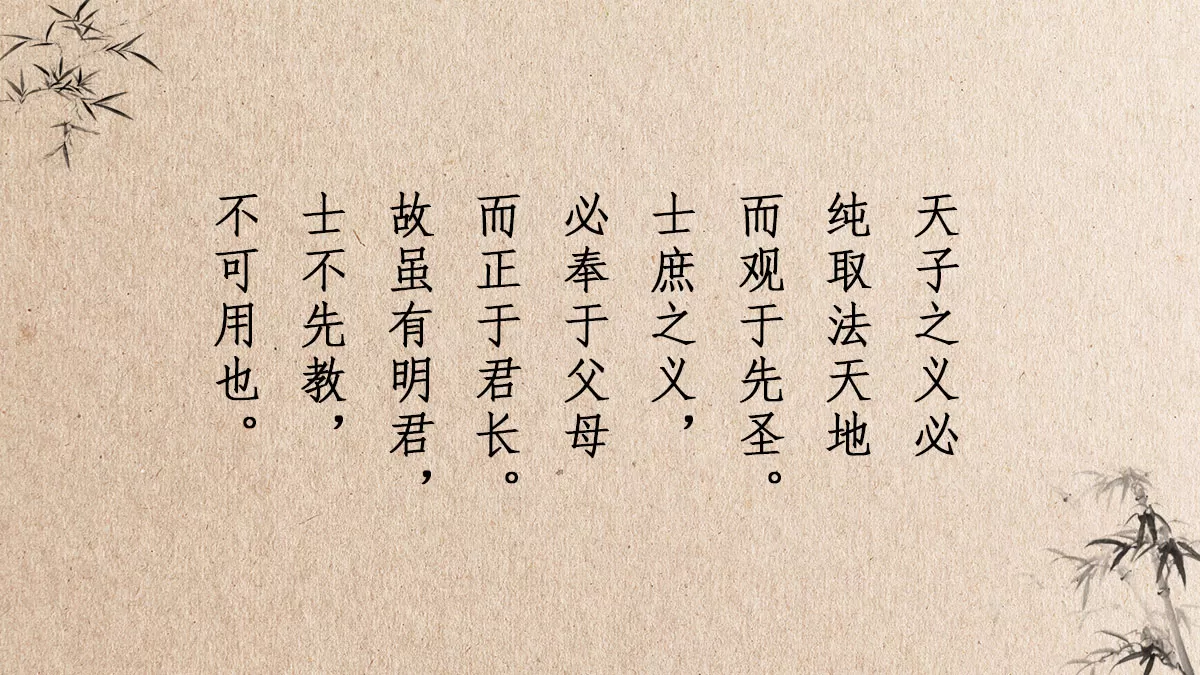
The Way of the Son of Heaven in conducting affairs must fully model itself on Heaven and Earth and take the sage kings of antiquity as its mirror. The Way of commoners and soldiers must follow the teachings of their parents and accept correction from their officers. Even with a wise ruler, if the soldiers have not first received education and training, they cannot be used in battle.
In ancient times, in educating the people, they invariably established an order of noble and base, superior and inferior, so that people would not oppress one another. Those with virtue and righteousness did not overstep their proper place; those with talent and skill were not buried in obscurity; those with courage and strength did not offend one another. In this way all could work with one heart and share the same purpose. In ancient times, the rites and rules of the court could not be taken into the army, nor could the wartime rules of the army be taken into the court. Thus virtue and righteousness did not encroach on each other. The ruler valued those who did not boast of their merits; those who did not boast of their merits were rare talents for a ruler. If a person did not boast, he had no excessive desires; without excessive desires, people would not contend with one another. In handling domestic affairs, one could surely learn the true situation; in handling military affairs, one could surely make proper arrangements, and those with talent and skill would not be buried. Soldiers who obeyed orders were given the highest rewards; those who disobeyed were punished severely. Therefore brave men did not dare to recklessly show off their strength and offend others. After the people had been fully educated, they were carefully selected and assigned tasks. When all affairs were well governed, the hundred officials could each fulfill their duties; when instruction was simple and clear, the people turned toward goodness; when habits were formed, the people naturally followed custom. This was the highest level of education.
In ancient times, they did not pursue a fleeing enemy too far, nor chase a retreating army with desperate persistence. By not pursuing too far, they were not easily lured by the enemy; by not chasing desperately, they were not easily trapped. They relied on rites and law to secure themselves and on benevolence to win victory. After victory, this system of education could still be carried on; therefore the virtuous gentleman set great store by it.
In the age of Yu Shun, warnings were issued within the capital, intending to make the people understand the commands. The kings of Xia swore their troops within the army, intending to make officers and soldiers think through battle plans in advance. The Shang swore them outside the camp gate, so that officers and soldiers would understand the intent beforehand and then act. The Zhou swore them only when the two sides were about to come to close quarters, in order to strengthen the troops’ fighting spirit.
The Xia emphasized rectifying virtue and did not yet frequently use weapons in killing, so the types of weapons were few. The Shang emphasized righteousness and began to use weapons in killing on a large scale. The Zhou emphasized reliance on military force and used every kind of weapon in close combat.
The Xia rewarded in the court to honor good conduct. The Shang punished in the marketplace to overawe the wicked. The Zhou had rewards in the court and punishments in the marketplace, encouraging the gentleman and warning the petty man alike. These three sage kings shared the same fundamental intention in promoting virtue.
If weapons are not properly matched, they are not easy to use. Long weapons are used for cover, short weapons for close defense. If a weapon is too long, it is hard to strike; if too short, it cannot reach the enemy. If too light, though sharp, it easily gets out of control once blows are exchanged. If too heavy, it becomes sluggish, and once sluggish it cannot do its job.
War chariots: in Xia they were called gouche, “hook chariots,” emphasizing keeping the ranks in order; in Shang they were called yinche, emphasizing swift movement; in Zhou they were called yuanrong, emphasizing fine equipment. Military banners: Xia used black, symbolizing that people should be as solid as the earth; Shang used white, taking the meaning of modeling themselves on Heaven; Zhou used yellow, taking the principle of modeling themselves on Earth. Insignia and emblems: Xia used the sun and moon, honoring brightness; Shang used the tiger, honoring awe; Zhou used the dragon, honoring refinement.
If discipline in the army pursues dignity to the extreme, the soldiers will be oppressed; if dignity is insufficient, the soldiers will find it hard to defeat the enemy. When a ruler employs the people unreasonably, the people lose their proper order, those with skills cannot exercise their abilities, oxen and horses cannot be used properly, and officials oppress those below them—this is dignity carried too far. When dignity is carried too far, the soldiers are oppressed. When a ruler does not honor virtue but puts the wicked and cunning in important positions; does not follow the upright Way but honors brute force alone; does not value those who obey orders but instead values those who disobey; does not commend good conduct but instead exalts violent behavior, and officials likewise bully their subordinates—this is insufficient dignity. When dignity is insufficient, the soldiers cannot win battles.
In military operations, calm steadiness is the main thing; only with calmness can sufficient strength be preserved. Even when the two armies engage and weapons clash, the infantry do not run in panic, the chariots do not gallop wildly, and in pursuing fugitives they do not break their ranks; thus there is no confusion. The solidity of an army lies in keeping its ranks unbroken, not exhausting the strength of men and horses, and in having speed and slowness never exceed what military orders prescribe.
In ancient times, court rites did not enter the army, and military rules did not enter the court. If military rules were used in the court, the virtue of the people would decay; if court rites were used in the army, the army’s fighting power would be weakened. Therefore in the court, speech was refined and gentle, conduct was respectful and modest, and one cultivated oneself in dealing with others. One did not step forward without being summoned, nor speak first without being asked; entering court to see the ruler was not easy, but withdrawing from office was decisive. In the army, one stood tall and upright; on the march, one acted decisively. Once clad in armor, one did not perform kneeling rites; sitting in a war chariot, one did not bow leaning on the crossbar; in mounting the city wall, one did not trot; when facing danger, one did not shirk. Thus rites and law were inner and outer to each other, and civil governance and military power were like a person’s left and right hands, completing each other.
The enlightened kings of antiquity promoted the people’s good virtue and fully aroused their good hearts. Thus there was no corrupted virtue, no negligent people; rewards had no place to be used, and punishments had no opportunity to be applied. In the time of Yu Shun, without rewards or punishments, the people could be directed at will—this was the age of the highest virtue. The Xia had rewards but did not use punishments; their education was excellent. The Shang used punishments but not rewards; their dignity was extremely heavy. The Zhou used both rewards and punishments, showing that virtue had already declined. Rewards must not be delayed; the people should quickly receive the benefits of doing good. Punishments should be carried out on the spot, so that the people immediately see the harm of doing evil. After a great victory, no extra rewards were given, and the whole army, high and low, did not boast of its merits. When those above did not boast of merit, they would not become arrogant; when those below did not boast of merit, they would not compete with one another. When high and low alike did not boast of merit, this was the highest level of humility. After a great defeat, the officers and soldiers were not executed; high and low alike regarded the fault as their own. When those above attributed the fault to themselves, they would surely reflect and correct their errors; when those below attributed the fault to themselves, they would try their utmost not to commit offenses again. When high and low together bore the fault, this too was the highest level of humility.
In ancient times, troops garrisoning the frontier were not called up again within three years, out of compassion for the people’s toil. When high and low showed such mutual understanding, this was the highest level of harmony. When they won a victory, they sang songs of triumph to express their joy. When hostilities ceased, they held a celebration of merit at the Ling Terrace, rewarding the people for their hardships and showing that they were to be given rest and recovery.
The Righteousness of the Son of Heaven's Pictures
Chapter 2 of Sima Fa: The Righteousness of the Emperor

- Verdana
- Georgia
- YaHei
- Regular
- A-
- 16
- A+