A Hundred Strategies of War
Summary
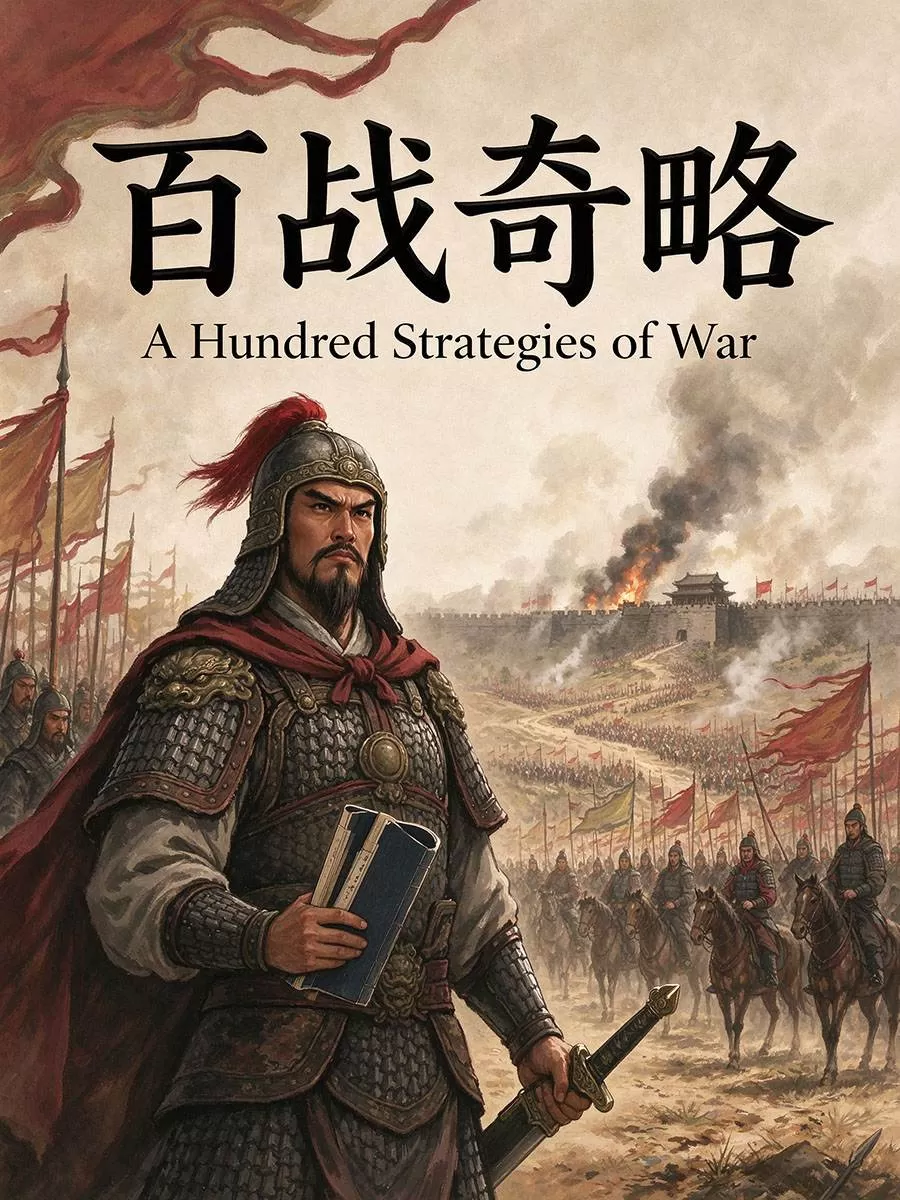
A Hundred Strategies of War is a military treatise written by Liu Ji (courtesy name Bowen), a military strategist active between the late Yuan and early Ming dynasties. Its hardcover edition was published by Jiangxi Education Press in 2016. As a...
Table of Contents
Introduction to A Hundred Strategies of War
A Hundred Strategies of War is a military treatise written by Liu Ji (courtesy name Bowen), a military strategist active between the late Yuan and early Ming dynasties. Its hardcover edition was published by Jiangxi Education Press in 2016. As a founding hero of the Ming Dynasty, Liu Ji possessed profound knowledge of astronomy and military tactics, and this book systematically lays out his military doctrines.
Rooted in The Art of War by Sun Tzu, the work draws on warfare cases from the Spring and Autumn Period through the Five Dynasties. It summarizes one hundred combat principles arranged in ten volumes, with each entry headed by a single-character title, covering strategy formulation, tactical implementation, and adaptation to environmental conditions. Through contrasting positive and negative battle records and dialectical analysis, it explores military concepts such as warfare based on calculation, warfare built on stratagem, and the interplay of the extraordinary and the orthodox. This newly annotated hardcover edition features a complete structure and boasts value for both academic research and collection.
Introduction to the Content
A Hundred Strategies of War is an ancient military work focused chiefly on expounding combat principles and operational methods. It was composed by Liu Ji, the renowned statesman, military strategist and military advisor of the Ming Dynasty. It occupies a notable place in the historical evolution of ancient Chinese military thought and military scholarship. Inheriting classical military wisdom represented by The Art of War by Sun Tzu, it synthesizes abundant military principles distilled from warfare practices across successive dynasties. Its ideology of analyzing war dialectically from objective reality exerted a major influence on the application and evolution of military thought after the Song Dynasty, and still offers valuable reference for the study of modern warfare patterns and guiding principles today. Adopting a compilation format with single-character headings for each clause, it integrates historical commentary with case evidence, grounding arguments in ancient military classics and illustrating them with ancient battles through comparative reasoning of successes and failures. It stands as the earliest surviving ancient military text of this kind and played a pioneering role in the history of Chinese military academia.
About the Author
Liu Ji (July 1, 1311 – May 16, 1375), courtesy name Bowen, was born in Nantian Township of Qingtian County (present-day Wencheng County, Zhejiang Province). He was a celebrated military strategist, statesman and litterateur of the late Yuan and early Ming eras. In literary history, Liu Ji ranks alongside Song Lian and Gao Qi as one of the "Three Great Prose and Poetry Masters of the Early Ming". A founding hero of the Ming Dynasty, he was famed for his extraordinary foresight and masterful strategic planning. In the third year of the Hongwu reign of the Ming Dynasty (1370), he was granted the title of Earl of Sincerity, hence also known as Liu Chengyi. In the ninth year of the Zhengde reign of the Wuzong Emperor, he was posthumously awarded the title of Grand Tutor with the posthumous name Wencheng, and later generations referred to him as Liu Wencheng or Duke Wencheng. Well-versed in classics and histories, astronomy and military arts, Liu Ji, together with Song Lian, Ye Chen and Zhang Yi, was hailed as one of the Four Distinguished Scholars of Eastern Zhejiang. He assisted Zhu Yuanzhang in seizing imperial power, founding the Ming Dynasty and striving to secure national stability. Zhu Yuanzhang repeatedly praised him: "He is my Zhang Liang." His renown spread far and wide. A popular folk saying goes: "Zhuge Liang secured three parts of the realm; Liu Bowen unified the whole nation. Zhuge Liang was the advisor of an earlier age; Liu Bowen was the advisor of a later age." He was regarded by posterity as the reincarnation of Zhuge Wuhou.
Influence of the Work
A Hundred Strategies of War shaped the main thread of military theory for six hundred years after its creation. It profoundly affected the application and development of military thought after the Song Dynasty, and remains an important reference for researching the laws and guiding principles of modern warfare in the present day.