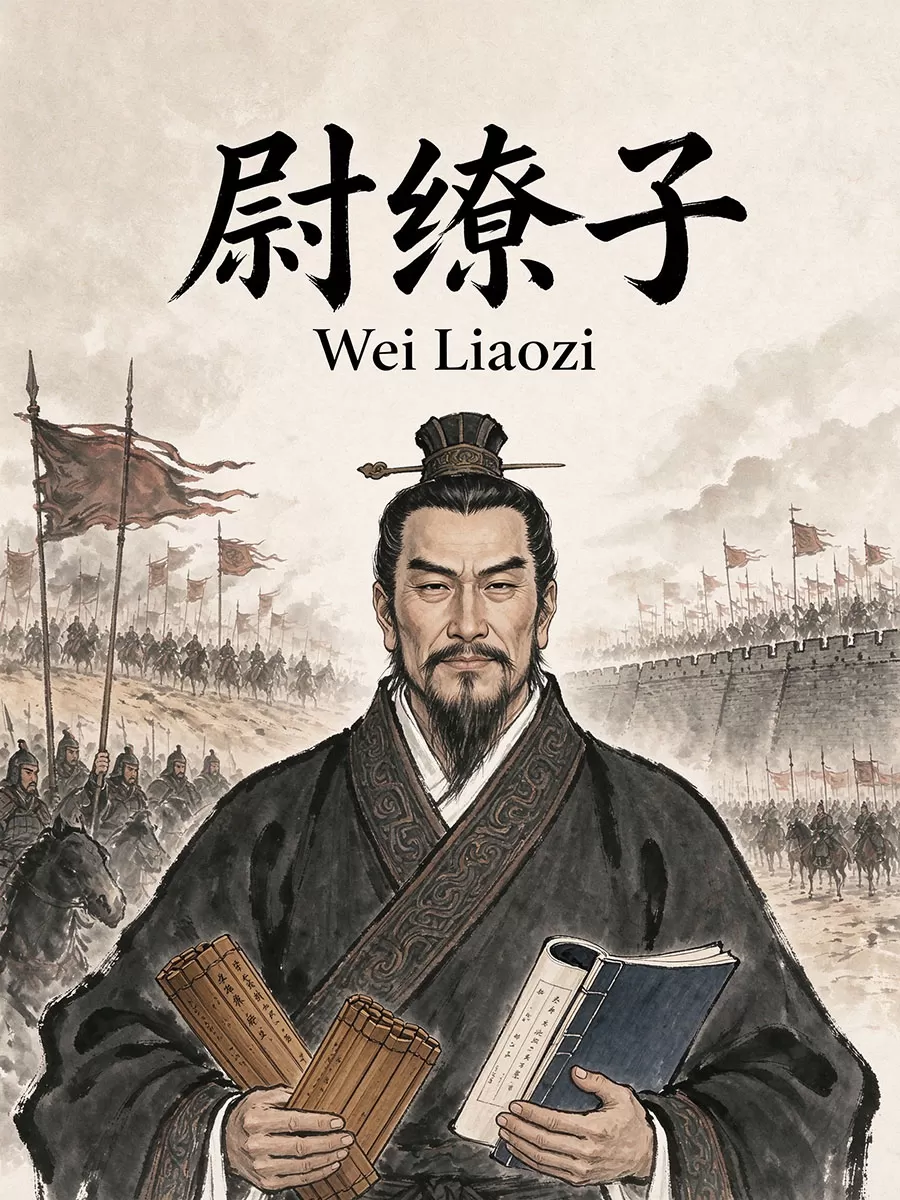
Wei Liaozi
Summary
Wei Liaozi is a military treatise written by Wei Liao, a strategist of the late Warring States Period. The original text was completed roughly between the end of the 4th century BC and the early 3rd century BC. Bamboo slip fragments unearthed from...
Table of Contents
- Chapter 1 · Heavenly Offices
- Chapter 2 · Discourse on Troops
- Chapter 3 · Discourse on Regulations
- Chapter 4 · Battle Prestige
- Chapter 5 · The Authority of Offensive Warfare
- Chapter 6 · The Authority of Defence
- Chapter 7 · The Twelve Heights
- Chapter 8 · Military Discourse
- Chapter 9 · The General’s Jurisdiction
Introduction to Wei Liaozi
Wei Liaozi is a military treatise written by Wei Liao, a strategist of the late Warring States Period. The original text was completed roughly between the end of the 4th century BC and the early 3rd century BC. Bamboo slip fragments unearthed from the Han tomb at Yinqueshan in Linyi, Shandong Province in 1972 have proven that it is not a forged work. The extant version contains twenty-four chapters. It was classified as a work of the Eclectic School in Bibliography of the Han Shu, and later compiled into Seven Military Classics under the Military School.
Integrating the ideas of the Legalist and Confucian schools, the whole book puts forward the strategic view that "victory in war originates from governance at court", advocating that politics and economics serve as the foundation of military strength. It stresses governing the army with severe laws and strict penalties, pioneering the collective responsibility system of mutual guarantee and guilt by association in military law, and systematically expounds tactical principles and military organization. It rejects superstition about destiny, ghosts and deities, and advocates a naive materialist view of warfare that "celestial calendars and auspicious timings are inferior to human efforts". Meanwhile, it attaches importance to combining morale stimulation with practical combat training, forming a military governance theory of "employing both punishment and virtue". Containing an early systematic military administration system of ancient China, the book carries great documentary value for the study of pre-Qin military institutions.
View of Warfare
Wei Liaozi divides wars into two categories: wars "fought for righteousness" and wars "waged for private gain and grudges" (On Offensive Power, edition of Continued Ancient Lost Books, same below). It endorses wars that "execute the violent and prohibit injustice", and opposes wars that "kill men’s fathers and elder brothers, seize their wealth and goods, and enslave their children". It emphasizes that the goal of war is to achieve feudal unification and "expand territory and unify institutions". It states: "For warfare, martial force is the trunk, and civil governance is the root; martial force is the outward form, and civil governance is the inner essence". It recognizes that politics is the foundation and military force is its branch and manifestation. It holds that economics determines victory or defeat in war, hence prioritizing farming and warfare and taking agricultural development as the foundation of state governance. Commerce exerts a major influence on war outcomes: "Markets supply provisions for defense and combat", and "One who commands the nation’s military without officials managing all commodities cannot be said to be capable of fighting". It also maintains that military victories promote domestic political and economic development: "Victories abroad bring blessings at home" (On Military Initiatives, bamboo slip edition). It advocates cautious warfare and reckless use of troops, holding that "mobilize when victory is foreseeable, and halt when it is not".
Thoughts on Military Governance
It attaches great importance to the legal construction of the army. It argues that an army must establish rigorous rules first: "For all troops, regulations must be fixed in advance", "clarify institutions beforehand and enforce stern punishments afterward". It stresses impartial rewards and penalties: "Punishment shall reach the superiors, and rewards shall extend to the subordinates". It formulates various ordinances covering mutual suretyship, camp zoning, sentry duties, prohibitions, battlefield reward and punishment rules, disciplinary authority of officers, combat formation and signal commands. At the same time, it requires law to be combined with moral education: "Establish courtesy and trust before granting ranks and emoluments, cultivate shame before imposing punishment, build affection before enforcing discipline". It demands "regulate openness and restriction, uphold a single principle", blending kindness and authority, combining ideological governance ("make men selfless") and material means ("regulate men based on their livelihood") to achieve good order. It values the selection of generals, sharply criticizes the hereditary general system of the time, and advocates "promoting the worthy and employing the capable" and "rewarding merit and honoring toil". Generals must set an example, be fair and upright, and possess the spirit of sacrifice: "A general forgets his family when taking command, forgets his kin when crossing borders, and forgets himself when facing the enemy". He should maintain harmonious relations with soldiers so that they obey orders "as limbs respond to the heart". For this purpose, redundant formalities should be abolished: "When demanding men to risk death, do not demand deference; when requiring men to exhaust their strength, do not demand ritual observance". It identifies three flaws in a general’s self-cultivation: "a reckless mind, deaf ears and blind eyes". It advocates streamlining troops and training elite soldiers. It clearly states that the purpose of military training is "to expand borders, defend the state, eliminate disasters and accomplish martial virtue". It lays emphasis on training methods, requiring unit-level drills starting from the basic five-man squad, progressive combined training from the bottom up under the charge of respective commanders, using rewards and penalties as incentives, conducting realistic and individualized rigorous training.
Operational Guidance
It recognizes three types of victory: victory through moral persuasion without fighting (Victory by the Dao), victory through deterrence to subdue the enemy (Victory by Prestige), and victory through direct engagement on the battlefield (Victory by Force). It stresses wartime preparedness, requiring superiority over the enemy in strategic decision-making, general selection and offensive theories. Before dispatching troops, commanders must carefully assess "internal and external balances", accurately grasp whether the enemy "has sufficient troops or shortages, surplus or insufficient grain supplies, and access routes". Plans shall be settled and considerations finalized early. It advocates seizing the initiative against the enemy: "He who applies stratagems first leaves the enemy powerless to engage; he who strikes first deprives the enemy of the will to resist. Thus warfare prizes initiative". It states: "Battle hinges on sustaining morale, offense on unexpected moves, and defense on outward preparedness". It stresses flexible application of objective laws: "The stratagem of warfare lies in the ultimate expression of the Dao" (On Battle Stratagem, annotated edition). It employs the tactic of "presence and absence" ("make the existent seem absent, the absent seem existent") and the use of orthodox and surprise forces to defeat enemies. It proposes: "Orthodox troops are suited for the first strike, surprise troops for follow-up strikes; either order serves to subdue the enemy". Different strategies apply to different situations: "For large territory with small cities, seize the land first; for large cities with narrow surrounding territory, attack the city first; for vast land with sparse population, block the critical passes" (Military Training II).
Military Dialectics
It stresses exerting human subjective initiative. It holds that reliance on ghosts and divination is inferior to focusing on human affairs, rejecting superstitious practices such as "divining by lonely void positions, observing the Xianchi asterism, reading tortoise-shell omens to foretell fortune and misfortune, and interpreting changes in stars, wind and clouds". It puts forward the view: "The past cannot be retrieved, the future cannot be awaited; one must rely on oneself". It advocates studying warfare through the connections of all things, understanding and applying the laws of military operations. It gains profound insight into the opposition and transformation of contradictions such as strength and weakness, offense and defense, presence and absence, concentration and dispersion, civil governance and martial force. Especially in understanding the relationship between military affairs, politics and economics, it embodies naive materialist and dialectical ideas surpassing many earlier thinkers.
Wei Liaozi discusses warfare by drawing selectively from the Legalist, Confucian, Mohist and Daoist schools, forming a distinctive style among pre-Qin military texts and exerting far-reaching influence on later generations. Military strategists of later ages frequently cite and interpret its ideas. More than thirty works studying Wei Liaozi have been produced in Japan, and printed editions also circulated in Korea. Its rich and detailed records of military institutions and orders carry important historical value. Nevertheless, its advocacy of harsh laws for state and army governance constitutes its dross.
As a Warring States military treatise, Wei Liaozi’s discussions on strategy and tactics are less profound than those in The Art of War and Wuzi, yet it presents original insights on a range of topics.
First, Wei Liaozi puts forward an economics-based view of warfare. In On the Root of Governance, it states that the foundation of state governance lies in farming and weaving: "Without grain crops, men cannot fill their bellies; without silk and hemp, men cannot cover their bodies".
Second, Wei Liaozi advances several valuable strategic and tactical ideas. It advocates concentrating superior forces and waiting for opportunities: "Concentration brings victory, dispersion brings defeat" (Military Orders I); "Troops are secured by stillness and victorious by concentration" (Military Authority). It favors pre-emptive and surprise strikes: "War prizes initiative. Victory here ensures victory elsewhere; failure here leads to failure elsewhere". It advocates stratagem in warfare: "He who applies stratagems first leaves the enemy powerless to engage". It uses the deceptive tactic of "make the existent seem absent, the absent seem existent" (On Battle Stratagem) to confuse the enemy. Inheriting Sunzi’s theory of orthodox and surprise forces, it proposes that "orthodox troops strike first, surprise troops follow, and either sequence defeats the enemy". Notably, drawing on the practice of siege warfare in the Warring States Period, it develops a complete set of stratagems for attacking and defending walled cities. It insists that an offensive must guarantee victory: "Do not speak of fighting unless victory is assured; do not speak of assault unless capture is assured". Troops shall penetrate deep into enemy territory, strike unexpectedly, sever enemy supply lines, isolate the city and seize it when opportunities arise. Four types of targets are prioritized for assault:
Cities with walls but no defense: river crossings unfortified, strongholds unrepaired, ramparts unbuilt, and caltrops unset;
Garrisons with listed defenders who are absent: remote outpost troops failing to withdraw and garrison soldiers not recalled;
Cities with stockpiles rendered unavailable: livestock not gathered inside the walls, grain not harvested, and supplies not collected;
Empty cities depleted of resources. Such cities shall be attacked without hesitation when vulnerabilities appear.
Its defensive stratagems mainly contain three points. First, it rejects the practice of "failing to defend outer suburbs when advancing and lacking outposts when retreating", advocating defense of key peripheral zones around cities. Second, ramparts and moats shall be constructed: "moats deep and wide, city walls solid and thick", with manpower, grain, fuel, powerful crossbows, sharp spears and ji halberds well prepared. A ten-foot section of wall requires ten defenders; a thousand-foot wall needs ten thousand defenders, excluding craftsmen and laborers for logistics. Third, a fortified city must have relief troops: "A city with reliable relief troops can be held; one without cannot". Relief forces must break the encirclement while garrison troops sally forth to seize strongholds. Relief troops shall also deceive the enemy to coordinate with defenders and crush the besieging army. These stratagems for siege and city defense are innovative ideas untouched by earlier military theorists.
Third, another major contribution of Wei Liaozi is its comprehensive set of military reward and punishment ordinances characteristic of its era. As an ancient military text, it not only develops military theories but also preserves many vital Warring States military ordinances rarely seen in other military classics.
In On Martial Prestige, it says: "Standardizing institutions and clarifying rewards and penalties" is the path to victory by prestige. In On Regulations, it states: "Enacting orders and clarifying rewards and penalties" are essential to spur soldiers to charge into battle. Wei Liaozi advocates governing the army by law, upholding generous rewards and heavy punishments. It holds: "Rewards and emoluments that are insufficient cannot encourage men". Meritorious soldiers shall be richly rewarded with farmland and official ranks so that "no rank may be obtained without battle", realizing the principle of "rewarding merit and honoring toil".
Wei Liaozi advocates severe punishment. In Severe Punishment Ordinance, it argues that only when soldiers "fear heavy punishment internally will they despise the enemy externally". Troops who suffer defeat, surrender or desert on the battlefield are condemned as "traitors of the state" and "traitors of the army". They face execution and the extermination of their families, removal from household registers, desecration of ancestral graves, and enslavement of their kin. Soldiers who fail to report on time or abscond are charged with desertion. Its Five-Man Unit Ordinance stipulates the guilt-by-association system for squads, and its Squad Formation Ordinance lays down battlefield disciplinary rules and "execution codes for combat", all reflecting the principle of heavy punishment. It writes: "Ancient masters of warfare could sacrifice half their troops; the next best sacrificed three-tenths; the inferior sacrificed one-tenth. Those who sacrificed half overawed the realm; those who sacrificed three-tenths prevailed over feudal lords; those who sacrificed one-tenth ensured orders were obeyed by all soldiers". It claims that only in this way can military decrees be "as formidable as battle-axes, regulations as sharp as Ganjiang swords, and no soldier dare disobey". This doctrine of severe punishment is highly consistent with Shang Yang’s theories of reward and penalty, and even harsher. It reflects the acute class antagonism between officers and soldiers in ancient military organizations. Its legalist approach to military governance differs greatly from practices before the Spring and Autumn Period. As mentioned earlier, its principle of "inflict heavy punishment on high-ranking offenders and grant generous rewards to low-ranking achievers" abolished the old aristocratic privilege of lenient punishment and lavish reward, embodying the enterprising spirit of the emerging landlord class and marking a qualitative break from the old norm of rewarding services.
Fourth, Wei Liaozi preserves other important military ordinances: Zoning Ordinance governs camp division, defining defense sectors for each unit and movement rules; Troop Formation Ordinance regulates battle arrays, specifying unique banner insignia for each unit, squad formations and distinctive badges for different ranks; Drill Ordinance unifies command signals of gongs, drums, banners and bells and defines their functions; General’s Ordinance stipulates that generals receive authority from the ruler, answer only to the sovereign and hold unified command of the army in the field; Rear Guard Ordinance governs follow-up units, regulating their distance from the main force, marching routes, missions, security, sentry protocols and handling of deserters; Military Training (I & II) sets rules for military drills, including camp deployment and reward and penalty systems during training. Its training methods clearly inherit certain principles from Wuzi. It also lists twelve ways to secure victory for rulers. For officers and soldiers, it states: "A general forgets his family when taking command, forgets his kin when crossing borders, and forgets himself when facing the enemy. Only by embracing death can one survive; craving quick victory is inferior. A hundred men drawing blades break enemy ranks; a thousand men drawing blades capture enemy commanders; ten thousand men drawing blades sweep across the world". It seeks to forge an invincible fighting force.
These military ordinances recorded in Wei Liaozi constitute precious materials for researching pre-Qin military institutions.